This page is available in English.
Choose your preferred language to view the siteLong vs. Short
Whether you choose to buy an asset or speculate on its decline, profitxbt gives you the tools to make the most of your investments. If you go long on an asset, your account gains value when the asset's price rises. Conversely, if the asset's price falls, your account value decreases. But, with profitxbt's versatile platform, you have the opportunity to open a position that profits from the Market decrease in price. This strategy is known as "going short," as opposed to "going long" when you buy.
Example: Going Long
Let's say Gold is trading at $2,000 per ounce, and you believe that the price of Gold will increase. You decide to buy 5 ounces at $2,000, making your total position value $10,000.
profitxbt offers leveraged trading, allowing you to trade without having the full position value. Instead, you only need to cover the margin, which is 1% of the total position size, amounting to $100.
If your prediction is correct, and the price of Gold goes up, you may decide to close your position. Let's say the Gold price rises to $2,100, and you decide to close your position.
To calculate your profit, you need to multiply the difference between the closing price and the opening price of your position by its size.
Profit = (2,100 - 2,000) * 5 = $500 because you had a "long" position.
Example: Going Short
Let's consider Oil, which is trading at around $74 per barrel. You anticipate negative news about the market that could impact the price of Oil negatively. You decide to sell 100 barrels at $74, creating a short position with a total value of $7,400.
Oil has a margin requirement of 1% (1:100 leverage), which means you need to deposit $74 as margin collateral.
Unfortunately, the news is disappointing, and Oil's price drops to $73.50. To secure your profit, you buy back 100 barrels at $73.50.
Since this is a short position, you calculate your profit by subtracting the closing price ($73.50) from the opening price ($74) and then multiply it by the position's size, which is 100.
Profit = (74 - 73.50) * 100 = $50 because you had a "short" position.
Profit from market growth
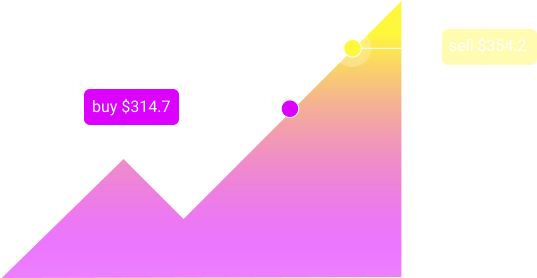
Profit from market decline

Calculating Profits
To determine the profit or loss generated from a long/short trade, you multiply the position's size by the point difference between the opening and closing prices. Both long and short trades result in profits or losses when the position is closed.
If you have confidence in the market's direction, you can utilize leverage to gain exposure to a larger position than with a standard trade, whether you're going long or short.
You are just moments away from trading
Open an account and start trading now – it's quick, easy, and only takes 40 seconds.